

Repurpose Blog Content: Turn One Blog Post Into a Complete Content System
Repurposing blog content means transforming one useful article into several formats, channels, and experiences without losing its original value. Instead of publishing a post once and allowing it to disappear in an archive, you can extract its strongest ideas and adapt them for newsletters, social media, videos, podcasts, presentations, downloadable guides, and sales conversations. This approach helps you work more efficiently, reach different audiences, and extend the lifespan of every thoughtful investment in research and writing.
A strong repurposing process is not simple copying. It is strategic translation. Readers on LinkedIn may want a concise professional lesson, while Instagram followers may respond to a visual checklist. A podcast audience may appreciate a story and detailed explanation, whereas an email subscriber may need one practical recommendation. The central message remains consistent, but the delivery changes to suit each platform, attention span, and stage of the buying journey.
For businesses, creators, educators, and marketing teams, this method creates a reliable content engine. It reduces pressure to invent new topics every day, reinforces brand authority, and gives valuable ideas repeated opportunities to be discovered. When executed carefully, repurposing also improves accessibility because people can learn through reading, listening, watching, or interacting.
What Repurposing Blog Content Includes
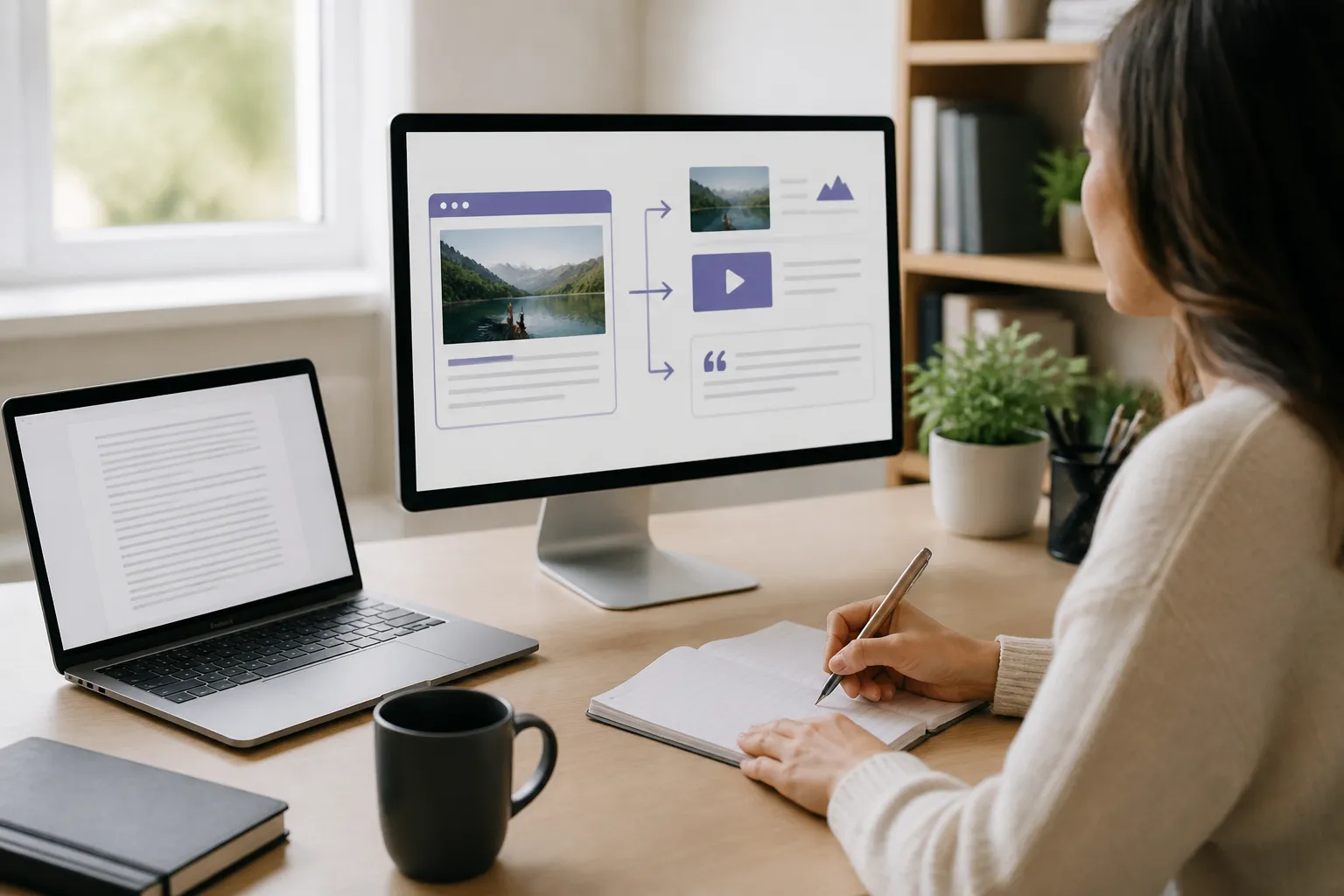
Repurposing begins by identifying the article’s core promise, supporting arguments, examples, data, and practical actions. Each element can become a separate asset. A five step process might produce a carousel, a short video series, an email sequence, a webinar outline, and a downloadable worksheet. A case study might become a client story, a sales enablement sheet, a podcast discussion, and several quote graphics.
Common Repurposing Formats
A blog post can be adapted into many useful formats:

- A newsletter can summarize the key lesson and direct readers to the complete article.
- Social posts can present individual insights, questions, statistics, or counterintuitive opinions.
- A carousel can explain a process one step at a time.
- A short video can demonstrate one recommendation or answer one common objection.
- A podcast episode can explore context, mistakes, examples, and expert perspectives.
- A webinar can expand the article into a guided teaching experience.
- A downloadable checklist can turn advice into an implementation tool.
- A sales presentation can connect the article’s solution to a customer’s business problem.
- An internal training document can help employees apply the same principles consistently.
The objective is not to produce the maximum number of assets. It is to create the right assets for your audience and business goals. Quality, relevance, and consistency matter more than volume.
Why Repurposing Is Worthwhile
Creating original content requires planning, research, drafting, editing, design, distribution, and measurement. Repurposing does not eliminate that work, but it makes the investment more productive. Once an article has established a useful foundation, much of the research and strategic thinking is already complete. Your team can spend more time improving presentation and distribution instead of repeatedly starting from an empty page.
Repurposing also supports repeated exposure. Most people do not see a post the first time it is shared. They may be busy, using another platform, or unfamiliar with your brand. A new format or angle gives the same idea another chance to reach them. Repetition builds recognition, and recognition strengthens trust when the information remains helpful rather than intrusive.

Another advantage is audience expansion. Some prospects never read long articles, but they may watch a sixty second video. Others discover brands through search, email, professional networks, or audio platforms. Repurposing allows one insight to travel across these environments while preserving a recognizable point of view.
The practice can also reveal content gaps. While converting an article, you may notice that an explanation lacks an example, a statistic needs updating, or a recommendation requires a template. Those discoveries improve the original article and guide future content planning.
A Practical Repurposing Workflow
1. Select a Strong Source Article
Begin with an article that has demonstrated value. Good candidates may have high organic traffic, substantial engagement, strong conversion rates, positive customer feedback, or enduring relevance. Evergreen topics are especially useful because their adaptations remain valuable for longer. However, a timely article can also perform well if you update facts and connect it to current conversations.
Do not select an article solely because it is popular. A post with many visits but weak business relevance may create attention without meaningful results. Consider whether its subject aligns with your expertise, audience needs, products, and current priorities.
2. Identify the Central Message
Write the article’s main promise in one sentence. Then list three to seven supporting ideas. Separate facts, opinions, examples, instructions, objections, and outcomes. This content map becomes the foundation for adaptation.
Ask what a reader should remember after finishing the article. That answer should guide every new asset. If a social post introduces an unrelated claim, or a video emphasizes a minor detail, repurposing becomes fragmented. Consistency does not require identical wording, but every format should support the same strategic message.
3. Match Ideas With Formats
Choose formats according to audience behavior and communication purpose. A complex comparison may suit a long video or webinar. A memorable statistic may work as a graphic. A sequence of actions may become a checklist. A personal story may perform well in a podcast or email.

Consider the resources available. If your team lacks video expertise, begin with text, audio, or simple screen recordings. If design capacity is limited, use reusable templates. An efficient system should be repeatable, not dependent on heroic effort.
4. Adapt Rather Than Duplicate
Every platform has its own expectations. A social caption needs a strong opening and one clear takeaway. A newsletter can add personal context and a direct reply request. A video needs a compelling first few seconds, natural speech, and visual movement. A downloadable resource should be scannable, practical, and easy to use.
Change the introduction, examples, length, structure, and call to action. Remove references that depend on the original article’s format. If the source says, “as explained below,” rewrite the sentence for its new environment. Adapted content should feel intentional, not like a paragraph cut from somewhere else.
5. Build a Distribution Schedule
Do not publish every adaptation simultaneously unless a coordinated campaign requires it. Space assets over several days or weeks, using each piece to reinforce the next. A newsletter can introduce the topic, social posts can develop individual points, and a webinar can provide deeper implementation. Later, a case study or customer story can demonstrate results.
Create a simple calendar showing the source article, format, platform, publication date, owner, link, and objective. Include an update date for time sensitive facts. This document prevents duplication, clarifies responsibilities, and makes the system easier to repeat.
Creating High Quality Adaptations
Social Media
Extract one specific idea per post. Avoid compressing an entire article into a vague summary. Start with a question, surprising observation, common mistake, or direct promise. Explain the point briefly, provide an example, and invite a relevant response. Strong posts can stand alone while offering a natural reason to explore the complete article.
Use platform appropriate language. Professional audiences may value frameworks and lessons, while community oriented channels may respond to practical stories. Do not rely on hashtags or decorative language to compensate for weak substance.
Email gives you room to add personality and context. Explain why the topic matters now, describe a problem the reader may recognize, and present one useful lesson. Link to the article for deeper detail, or invite the subscriber to use a related template. A focused email usually performs better than a crowded digest containing every available asset.

Segment when possible. Beginners may need definitions and simple steps. Experienced subscribers may prefer advanced examples, benchmarks, or strategic implications. Personalization is persuasive when it improves relevance rather than merely inserting a name.
Video and Audio
Convert headings into talking points, not a script that sounds like an article being read aloud. Open with the audience’s problem and promise a clear outcome. Use examples, transitions, and a practical conclusion. For video, add captions, visual demonstrations, highlighted phrases, and clear framing. For audio, provide verbal signposts so listeners can follow without seeing the structure.
Keep each episode focused. One article may support several short videos instead of one overloaded presentation. This approach improves retention and creates more opportunities for distribution.
Downloadable Resources
Worksheets, templates, checklists, and guides make advice actionable. Convert abstract recommendations into fields, prompts, decision points, or examples. Include brief instructions, but leave enough space for the user to work. A resource should help someone complete a task, not simply restate the article.
Add a clear next step. Users may be invited to compare their answers, request an assessment, join a workshop, or read a related guide. The call to action should logically follow the value already provided.
Search, Accessibility, and Conversion
Repurposing should support discoverability without creating duplicate, low value pages. Give each adaptation a distinct purpose, title, introduction, and audience context. Link related assets thoughtfully, using descriptive anchor text. Update the source article when new data, regulations, tools, or examples make older advice incomplete.
Accessibility improves reach and user experience. Use readable contrast, descriptive image text, captions, transcripts, meaningful headings, and plain language. Avoid placing essential information only inside graphics. Provide keyboard friendly documents and explain acronyms when audiences may not know them.
Conversion should be measured according to the asset’s role. An awareness post may be successful when it earns qualified reach or profile visits. An email may be judged by clicks and replies. A checklist may generate registrations, while a webinar may influence opportunities. Define the intended action before publishing so that performance is interpreted fairly.
Measuring and Improving Performance
Track each adaptation separately, but evaluate the system as a whole. Useful metrics include reach, watch time, completion rate, saves, shares, click through rate, downloads, replies, registrations, assisted conversions, and revenue influenced. Qualitative feedback matters too. Comments and sales conversations can reveal which questions remain unanswered.
Compare formats by objective, not by raw traffic. A small audience of highly relevant buyers may be more valuable than a large audience with little connection to your offer. Look for patterns: perhaps practical checklists earn saves, customer examples create qualified leads, and short videos attract new visitors. Use those findings to guide future investment.
Refresh successful adaptations instead of abandoning them. Change the opening, add a current example, update a statistic, answer a new objection, or combine several posts into a stronger guide. Repetition becomes stale only when it provides no new context or usefulness.
Common Mistakes to Avoid
One frequent mistake is changing the format without changing the experience. A copied paragraph placed on every platform may technically be repurposed, but it will rarely perform well. Another mistake is producing too many assets without a distribution plan. More content can create more maintenance, confusion, and inconsistent quality.
Avoid extracting ideas from outdated articles without reviewing accuracy. Old claims can damage credibility and create compliance risks. Also avoid hiding every useful detail behind a form. Generosity builds trust; a resource should offer genuine value before requesting contact information.
Do not measure success only through vanity metrics. Likes and impressions can be encouraging, but they do not automatically indicate relevance, learning, or commercial impact. Finally, do not ignore internal audiences. Sales, support, recruiting, and customer success teams may gain significant value from clear, reusable explanations.
FAQ
How often should a blog post be repurposed?
There is no universal schedule. Start with one strong article each month, then adapt the process after observing workload and results. Evergreen articles can be revisited quarterly or whenever audience questions change. Timely articles may need faster updates and shorter distribution windows. The quality and usefulness of each adaptation matter more than a fixed frequency.
Should every blog post be repurposed?
No. Choose articles with meaningful audience demand, strategic relevance, sufficient depth, or proven performance. A thin announcement, outdated opinion, or highly narrow update may not justify multiple formats. Sometimes the better decision is to improve, combine, redirect, or retire the source article before creating adaptations.
Is repurposing the same as reposting?
Reposting publishes substantially the same material again. Repurposing transforms the material for a different format, platform, context, or audience need. Reposting can be appropriate for evergreen social content, but it should still respect platform rules and provide a reason for renewed attention. Effective repurposing adds interpretation, utility, or a new experience.
Can repurposing hurt search performance?
It can create problems if you publish near identical pages with no distinct purpose, misleading titles, or poor quality. Avoid mass producing thin pages. Give each web asset unique value, use appropriate canonical practices when necessary, and prioritize people over keyword manipulation. Social, email, audio, and video adaptations generally serve different discovery experiences.
What tools are useful?
A content management system, spreadsheet, project board, design templates, transcription software, analytics platform, and scheduling tool can support the workflow. Choose tools based on your process rather than buying a large collection. A clear content map and responsible ownership usually create more improvement than sophisticated software alone.
How do I maintain a consistent brand?
Create simple guidelines for voice, terminology, visual identity, claims, examples, and calls to action. Use a review checklist covering accuracy, accessibility, links, permissions, and compliance. Consistency comes from shared principles, while adaptation allows each platform to sound natural.
Should I use artificial intelligence?
Artificial intelligence can help summarize, outline, transcribe, generate variations, and identify themes. Human review remains essential for accuracy, originality, tone, privacy, and strategic judgment. Treat generated drafts as starting material. Add firsthand experience, evidence, nuance, and editorial responsibility before publication.
Conclusion
Repurposing blog content is a practical way to multiply the value of expertise already created. It strengthens distribution, supports different learning preferences, extends evergreen assets, and gives your audience more useful opportunities to engage. The most effective systems begin with a valuable source article, isolate its central ideas, match those ideas with suitable formats, and adapt every asset for its intended environment.
Start modestly. Choose one strong article, create a content map, produce three genuinely different adaptations, and schedule them with clear objectives. Measure meaningful outcomes, collect audience feedback, and improve the process before expanding. Over time, this disciplined approach can turn isolated blog posts into a connected library of education, trust, and action.
The persuasive advantage is simple: you do not need to work endlessly to remain visible. You need to make each worthwhile idea travel farther, teach more effectively, and continue serving people after its first publication. When strategy, creativity, accessibility, and measurement work together, repurposing becomes more than a production shortcut. It becomes a durable growth system built on the knowledge your brand already owns.