


Repurpose Blog Content for Maximum Reach
Repurposing blog content means transforming one useful article into several formats, channels, and experiences without simply copying it everywhere. The goal is to preserve the original insight while adapting its structure, length, visuals, and delivery for different audiences. A strong repurposing system can extend the life of an article, attract people who prefer video or audio, and create consistent publishing material without requiring an entirely new idea each time.
The process begins with substance. Choose an article that answers a meaningful question, contains clear examples, reflects your expertise, or has continued relevance. Then identify its strongest claims, practical steps, quotations, data points, stories, and questions. Each element can become a separate asset. A blog post may provide the foundation for a newsletter, short social posts, a video outline, an infographic, a podcast segment, or a downloadable checklist.
Repurposing is not an excuse to publish thin variations. Every adaptation should fit its platform and give the audience a reason to engage there. A short video needs a clear opening and one focused lesson. An email should create a personal reading experience. A carousel should turn a process into easily scanned steps. When content is adapted thoughtfully, one well researched idea can reach people repeatedly without feeling repetitive.
Choose the Right Blog Posts
Not every article deserves equal repurposing effort. Start by reviewing your archive and sorting posts according to usefulness, relevance, originality, and evidence of reader interest. Evergreen guides are usually excellent candidates because their core advice remains valuable over time. Detailed tutorials, comparison articles, research explanations, case analyses, and frequently asked question posts also contain multiple extractable ideas.
Performance data can help, but it should not be the only criterion. An article with modest traffic may address an important problem for a valuable audience. Conversely, a highly visited post may depend on outdated information or a temporary trend. Examine comments, search queries, email replies, sales conversations, and customer questions. These signals reveal which parts of a topic deserve clearer explanation.

Before adapting an article, check its accuracy. Update obsolete references, broken links, changing procedures, product details, and claims that require current context. Repurposing outdated material multiplies confusion rather than reach. Decide whether the article needs a light refresh, a substantial rewrite, or retirement. A refreshed foundation makes every later format more reliable.
Build an Extraction Brief
Create a short brief before producing assets. Record the article’s central promise, intended audience, primary problem, recommended action, supporting points, examples, objections, and conclusion. Add the article’s publication date, update needs, and any boundaries around claims. This brief prevents random clipping and keeps every format aligned.
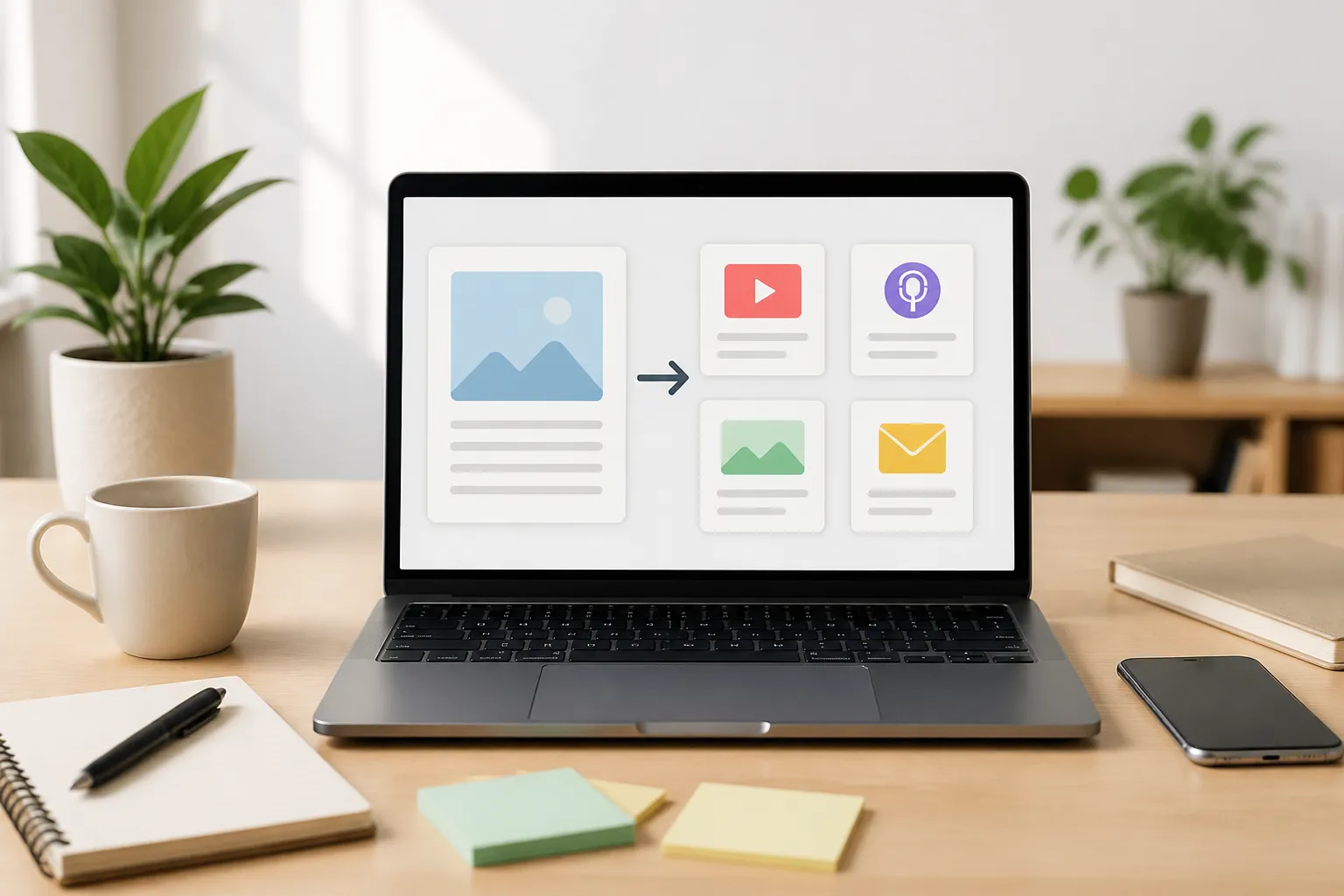
Next, divide the article into content units. A unit might be a definition, mistake, method, example, warning, statistic, or question. Label each unit according to its best use. For example, a three step method could become a carousel, a tutorial video, and an email lesson. An objection could become a social post that starts a discussion. Organizing ideas first makes production faster and improves consistency.
Match Formats to Audience Intent
Different formats serve different moments. People reading a full article may want depth, context, and a complete answer. People watching a short video may want one immediate takeaway. Someone opening an email may respond to a personal explanation and a practical next step. Your job is not to force every idea into every format, but to select the format that makes the idea easiest to understand.
Short Social Posts
Extract one useful point at a time. State the problem, explain the insight, and offer an action. Avoid compressing an entire article into a dense paragraph. A series of posts can cover several lessons over multiple days, while each post remains understandable on its own. Use concrete wording rather than vague encouragement.
A post can also challenge a common assumption, summarize a mistake, present a before-and-after process, or ask a focused question. If the original article includes a detailed framework, publish one principle per post and link to the complete explanation where appropriate. Do not make the link the only value; the post should still teach something.
Video and Audio
Turn the article’s structure into a script, not a reading. Open with the audience’s problem, establish why it matters, and deliver one clear promise. Then present the steps in an order that works when heard. Replace visual references such as “see the table above” with spoken explanations. Add examples, pauses, demonstrations, or screen recordings when they improve comprehension.
A long article may support several short videos rather than one crowded presentation. Each video should answer a specific question. The same recording can often become an audio segment, provided the wording remains natural without visual support. Remove references to captions, charts, or on-screen text when adapting for audio.

Newsletters
An email should not merely announce that a blog post exists. Reframe one lesson as a direct note to the subscriber. Explain a common difficulty, share the relevant principle, and suggest a small action. Then invite readers to explore the full article for examples or details. This approach respects the email format and gives subscribers immediate value.
Personal context can make a newsletter stronger, but avoid inventing experiences or implying results you cannot support. Use a real observation, a practical scenario, or a clearly labeled hypothetical example. Keep the message focused. One useful lesson is usually more persuasive than a crowded summary.
Visual Assets
Infographics, diagrams, checklists, and presentation slides are effective when the source material contains sequence, contrast, or classification. Convert paragraphs into labeled sections and show relationships visually. A checklist should contain observable actions, not broad promises. A diagram should simplify the idea without removing a qualification that changes its meaning.
Design should support comprehension rather than decoration. Use readable type, sufficient contrast, consistent terminology, and a logical order. Include enough context that the visual remains useful when shared separately from the original article. If a claim depends on a date, definition, or source, include that context or direct viewers to a fuller explanation.
Adapt Content Instead of Duplicating It
Effective repurposing involves editorial transformation. Change the opening, organization, examples, and level of detail according to the channel. A blog article can begin with a broad explanation, while a video may begin with a surprising mistake. A professional network post may emphasize a business implication, while a community discussion may invite people to compare experiences.
Avoid publishing identical wording across platforms. Repetition can reduce attention and make the brand appear automated. More importantly, identical text may ignore what users expect from each channel. Adapt vocabulary, pacing, visual presentation, calls to action, and interaction style. Preserve the central truth, but redesign the path to it.

Preserve Accuracy and Context
Short formats create pressure to simplify. Simplification is useful only until it changes the claim. If an article says a tactic can help under certain conditions, do not turn it into a guarantee. If a method has tradeoffs, mention the most important one. If an example is hypothetical, label it clearly. Responsible adaptation strengthens credibility.
Use a source note or link when evidence, definitions, or changing information matter. Keep records of dates, permissions, and original creators for images, quotations, and third party material. Repurposing your own writing does not automatically grant permission to reuse someone else’s content. Credit and licensing requirements should be handled before publication.
Create a Repeatable Workflow
A practical workflow separates strategy, extraction, production, review, and distribution. Begin with a content inventory. Mark articles as evergreen, seasonal, timely, or obsolete. Select pieces that support your current audience needs and business priorities. Establish one main objective for the repurposing cycle, such as building awareness, nurturing subscribers, or supporting a product education campaign.
During extraction, identify the article’s content units and assign formats. During production, batch similar tasks: write several social posts together, record related videos in one session, or design a group of visuals using a consistent template. Batching reduces setup time while still allowing each asset to receive individual editorial attention.
Review every asset separately. Check accuracy, clarity, accessibility, grammar, links, captions, image descriptions, and platform requirements. Confirm that the call to action is appropriate. A social post may invite a response, while a newsletter may invite a click or reply. Do not assume that a technically correct asset is strategically effective.
Schedule distribution with enough spacing to avoid audience fatigue. A single article can support a launch sequence, a follow-up discussion, and a later seasonal reminder. Spacing should depend on relevance, platform behavior, and audience expectations rather than a rigid formula. Maintain a calendar that records the source article, adapted formats, publication dates, and update deadlines.

Measure Reach and Learning
Measurement should go beyond impressions. Track meaningful actions for each format: completed video views, saves, replies, clicks, downloads, registrations, or qualified conversations. Compare performance with the format’s purpose. A discussion post may succeed through thoughtful replies even if it receives fewer views than an entertaining clip.
Look for patterns rather than treating one result as a universal rule. If short videos attract attention but produce few visits, improve the connection between the lesson and the next step. If newsletters receive clicks but low replies, make the prompt more specific. If a visual earns saves, examine which structure made it useful and apply that lesson elsewhere.
Use performance insights to improve the original article as well. Questions raised in comments can reveal missing sections. Repeated confusion may indicate a weak explanation. High interest in one subsection may justify a separate, deeper guide. Repurposing therefore becomes a feedback loop: the article generates formats, audience responses reveal needs, and those needs guide future content.
Avoid Common Mistakes
The first mistake is choosing quantity over usefulness. Publishing ten shallow adaptations rarely beats publishing three strong ones. The second is changing only the headline while leaving every sentence intact. The third is ignoring accessibility, including missing captions, unreadable graphics, poor contrast, or unexplained acronyms. The fourth is sending every audience member to the same call to action.
Another mistake is failing to refresh the source. Dates, tools, policies, examples, and recommendations can become inaccurate. Establish review triggers for subjects that change frequently. Finally, avoid measuring success only through visibility. Reach matters, but trust, comprehension, return visits, and useful action matter more when the goal is sustained growth.
FAQ
How many formats should one article become?
There is no universal number. Start with formats your team can maintain and your audience actually uses. One article might support a newsletter, three focused social posts, and a short video. Another may deserve an infographic and a webinar outline. Quality, relevance, and consistency are better guides than an arbitrary output target.
Should every article be repurposed?
No. Repurpose content when it contains durable value, a clear lesson, or evidence that readers need the topic. Retire articles that are inaccurate, redundant, too narrow for your audience, or dependent on information that can no longer be supported. Selectivity protects your time and your reputation.
How can repurposing avoid audience fatigue?
Vary the angle, format, timing, and depth. Teach one principle in a short post, demonstrate it in a video, and explore its limitations in an email. Avoid repeating identical wording and calls to action too closely together. If an audience has already seen the basic lesson, offer an example, update, or more advanced application.
Is it acceptable to use artificial tools for adaptation?
Tools can help with transcription, outlining, resizing, captioning, and early drafts, but human review remains necessary. Check every statement against the source, remove invented details, preserve qualifications, and make the language fit the intended audience. Automation should reduce mechanical work, not replace editorial judgment.
How long should a repurposing cycle last?
Choose a period that matches the topic and publishing capacity. A timely announcement may need a concentrated sequence, while an evergreen guide can support useful adaptations over months. Leave room for audience responses and updates. A calendar should be flexible enough to pause or revise material when circumstances change.
What should the call to action be?
Choose one action that matches the asset and the reader’s stage. Invite a response when conversation is the objective, offer the full guide when deeper context is needed, or suggest a relevant next step when the audience is ready. Avoid stacking several competing requests into a small format.
Conclusion
Repurposing blog content works best when it is treated as editorial design, not mechanical duplication. Begin with a trustworthy, useful article. Extract its distinct ideas, match each idea to a suitable format, adapt the language and structure, and preserve important context. Then distribute the assets with spacing, measure meaningful behavior, and use audience feedback to improve both future adaptations and the source material.
A disciplined system lets one strong idea serve readers in several ways without lowering standards. The article provides depth; short posts provide quick insight; video and audio provide demonstration and convenience; newsletters provide relationship and continuity; visuals provide scanning and memory support. Together, these formats expand reach while keeping the message coherent.
Choose one relevant article today, create an extraction brief, and select two formats your audience genuinely values. Produce those adaptations carefully, review them for accuracy and accessibility, and record what happens. Consistent, thoughtful repetition will usually outperform hurried volume because it respects both the original idea and the people you want to help.